Tuesday, June 25, 2013

Moving right along.

Moving. It is an interesting exercise in polarity; it is positive and negative, stressful and therapeutic, sends you forward and backward, and it is both an ending and a beginning. Since the age of 18, moving has been a part-time profession for me, often occurring more than once a year and often is out of necessity or for employment. I have actually moved 15 times in 12 years with my current, soon to be former house, taking the cake for longest held rental at 3 years. If you do the math that actually means that I moved 14 times in the previous 9 years which makes me judge myself a bit. Looking back at why I move, it often has more to do with school, work, or location (and sometimes involved a storage unit and a stay with parents) but I am also simply growing up and looking for different qualities in a house and neighborhood. In the last few years, the decision to move has also involved the commitment to live with my partner, in turn integrating both our possessions, pets, and lifestyles to see if we can thrive as a family. (Which, thankfully after three years, we most definitely are thriving.)

At this point, the decision to move is a culmination of frustration with our continuous struggle dealing with non-licensed yahoos, I mean contractors, sent to "fix" our failing apartment, the sale of our rental house, and the often excessive amounts of "character" found on our block. No, my dear neighbors, I am not working tirelessly all day long so I can come home and give you _____ (money, a beer, a ride, or my number) so you can leave trash in my yard and wake me up with late night shouting matches. Plus, there are only so many times you can have your truck run into by drunk drivers and stolen cars in high speed chases before you draw a line (I know, I know...I am so high maintenance). Needless to say, a line has been drawn and I am more than happy to move to greener pastures. 

Interestingly, despite the negatives, looking for good affordable housing in Charleston has revealed that we were actually quite lucky with our apartment. Not that this is a total shock considering we were thrilled to find it initially and have spent a better part of three years enjoying the apartment layout, our housemates, the general location, and the epic backyard. The pickings are pretty slim for the amount of rent we have been paying, so it became apparent that it was going to be a process. As with anything in my life, I did not let the dismal selection of housing in our price range discourage me but instead took it on as a personal challenge. If you need advice on property managers, the best neighborhoods, how to describe your dogs in non-threatening ways, or how to handle the awkwardness of being a shown rentals at the same time as two other interested people- I am your woman. (And don't worry on the last one- you don't have to cage fight, bribe with cash, or run in yelling "I'LL TAKE IT!!" before knowing what you are renting.)

After two months of hunting the proverbial housing snipe, I managed to secure a cute little rental house in an awesome neighborhood thanks to a lead from a good friend. So now we find ourselves ready to move forward and focus on a positive and exciting new adventure. The only hiccup? We have A LOT of stuff and our new place is several hundred square feet smaller. I have inherited absurd amounts of heirlooms, sentimental knick knacks, and other cool doodads. Ariel from The Little Mermaid doesn't have a dingle hopper to my collection of snarfblats. Add to that hobbies like biking, sewing, hooping, and gardening and I have myself an entire box truck full of fun stuff. Sorting through it all inevitably results in an introspective process for me- something I always enjoy. Picking through the flotsam and jetsam of my life leads me to relive experiences, remember people that have touched my life, and ultimately forces me to decide what to keep with me and what to let go of. 

After watching our friends with a tiny house reduce their possessions down to 300 items total, downsizing a few boxes and gadgets seemed like a completely manageable task. Not afraid of a little material possession cleanse, we chose to re-home many of our things through a yard-sale. With the help of Dan's wonderful mother, the support of many of our friends, and the awesome taste of our neighbors, we were able to re-distribute our things into the community.

The turkey hat and faux beard are happily living on John's Island now where thankfully I will have visitation rights. 

Pam Kelley, moving expert. Gavin and Kate, moral support.

We also had to face the reality that we could not take our two darling chickens with us to our new home, so we reached out to some of our friends to find a safe place for them to move. Thankfully, one of Dan's co-workers is quite the animal whisperer with a beautiful spread in Ravenel where they will be loved and free to roam. 

Mother Clucker with Pecan getting comfortable in her Eggloo.

Van, chicken adopter, critter whisper, and trailer lender. 

As if that was not amazing enough, Van and Kim also let us use their horse trailer to move our remaining hoard AND Van lent us his muscles for some serious heavy lifting alongside our friend John. So, roughly three months after our initial search began, one yard-sale, several horse trailer loads, and two less chickens we are in the homestretch completing our transition to a new house thanks to the love, support, and lifting of friends and family. Our lives are currently in boxes, our pets are needier that ever, we are sleeping on a futon, and we still have to sell several pieces of furniture but I am still beyond excited about our new adventure. After a walk with the dogs on the greenway, dozens of friendly "hellos", and a cocktail on my quiet front porch I had no doubt that we were definitely moving in the right direction. 

Here's to new beginnings and the interesting-life-altering-challenging-unexpected paths that take us there. 

Thursday, May 30, 2013

Busy Bee.

So much to do, so little time. We all experience it- the feeling that there is never enough time. We vow to "make more time" for ourselves, our families, our community. The trouble is, we inevitably become caught up in the daily routine and focus our energy on the immediate demands. As Tim Kreider with NY Times so aptly described, many of us fall into the "Busy-Trap". 

As someone that loves their job, it is easy to work all the time, especially when a perceived sense of urgency exists. I often convince myself that if I just reach _____ (insert any number of goals here) that I will take a break- which of course simply results in myself constantly pushing towards new goals and deadlines. For those of us that must be "on" and social for our jobs, there is often little juice left for friends and family- something I really struggle with. 

The challenge comes in recognizing your own personal limitations, letting go of the need to be everything to everyone all the time, and knowing when and how to say "no". In a society that rewards those that push themselves to the limit, this is a challenge because you generally do not receive awards for calling your mother regularly, leaving work at 5, and making time for family dinner. This rings especially true in Charleston, a city of overachievers. I was lucky enough to be honored in two publications this spring as one of these individuals (see pictures below from Charlie Magazine and Charleston Regional Business Journal). 


Reading about my fellow awardees resulted in a odd mix of inspiration, pride, and self-depreciation. There are so many amazing people doing incredible things that it inevitably makes you feel like you should be doing more. I guess that is the curse of being an overachiever- always feeling like there is more we can achieve as individuals. The passion that I have for my job tends to absorb so much of energy that I end up reaching my work goals while those I have set in my personal life tend to be neglected. Yet, as I sat waiting to receive my award for 40 under 40, I quickly realized that this is a pattern of behavior experienced by many of my fellow diagnosed overachievers. When I teased the awardee sitting next to me at the ceremony for checking his watch, he admitted that he felt guilty for once again missing a night spent with his new baby. 

With this in mind, I propose a new set of awards. Awards that acknowledge the parts of our lives often over-looked, the unsung heroes, the people that give themselves everyday without thought of awards, paychecks, or publications. I want to win an award for the best letter writer, amazing pet owner, the most fun partner, the most generous gardener, the most often to call/email/text family member.  

Here is to winning at life. 


Tuesday, October 9, 2012

Why hello there.

Long time, no see.

The last few months have been a roller coaster of ups and downs full of change, travel, loss, new adventures at work, serious illness, and celebration. While I had hoped to have the time and energy to share all of these experiences with you through my blog, it would seem that life had other plans. I am hoping to get back on track and begin sharing with you all again.

A major factor in this is due to a recent meeting. At one of many weekend fundraising events for work, I bumped into a woman that has been in the charleston "green" circles with me since I first moved to the area. Amazingly enough, her and I have talked over email and through blogs for years but the other night was one of the first times we actually were able to talk in person. She shared with me how much she had enjoyed following my adventures through my car free blog and that she had read them aloud to her whole family (minus a few choice words I may have used). Hearing how much they had relished living vicariously through my experiences and mis-adventures was so heartwarming...and honestly very flattering. While I have struggled to keep up this blog, her comments reignited my desire to share my stories with anyone that is interested in reading. Often, I will have to simply share the articles that I write for publications but in between I will try and carve out a little time to post some personal stories.

That being said, here are the latest articles that I have had published for your reading pleasure. As always, the final edited article is often cut down from the original, but hopefully you will enjoy them all the same. These were all featured in the latest issue of Dirt Magazine:

Farm to School

Permaculture

Foraging

Until next time, I hope you are all doing well!

Nik

Wednesday, April 18, 2012

The Art of Gardening

Here is my latest article about gardening printed in the City Paper... make sure you visit the site to see all of the great pictures! Not my best work but hopefully something to get you motivated in your own gardens :-)

This time of year, it is easy to find yourself intoxicated by the perfect blooms of potted flowers at a garden center and end up at the check-out line buying a cart full of plants with no idea what they are or where you will put them. With a long growing season, a warm climate, and the ability to grow an incredible range of plants here in the Lowcountry, it is no surprise that so many people are inspired to roll up their sleeves and dig in the dirt. But before you find yourself seduced into impulse plant purchases that may not be right for your lifestyle or yard, consider seeking a little inspiration and advice from a few local gardening gurus.

One local gardener who has mastered a number of these gardening styles is none other than Jim Martin, a man who has influenced so many of the beautiful public spaces in Charleston. By the time you have completed a full tour of his garden, it is hard to remember that you have ever been in another. Created with a circular flow, the house and garden ease seamlessly together, filled with unique treasures that speak to world travels and an eye for detail. Martin and his partner David Vegasky have spent the last decade making their garden a place to relax and entertain. Martin explains that in his home garden, "It is not about control. We have busy lifestyles and things are not always perfect in the garden and we make no apologies for that." Trust us, no apologies are necessary.

The tour begins with the intimate side garden which envelopes you with its secret nooks, cool shaded spaces, comfortable chairs, and ordered chaos of plants. Formerly the croquet green, its future was sealed when Martin and Vegasky redesigned it on a napkin at a pub in Asheville. The official transformation had its fateful start on Sept. 11, 2001, to which Vegasky noted, "I don't think of the tragedy, I think of what we created." The former patch of lawn was renovated by building up mounds of soil around a focal point, a tree given by Martin's former mentor, and then filled in with a variety of plants tolerant of part-shade. It was comforting to hear that such a beautiful garden was born on a napkin, built with what was available locally, and tended in their spare time.

Moving from one section of their garden to another is akin to walking from room to room in a home; they have created walls of foliage. I was completely surprised to discover an in-ground pool hiding around the bend, complete with brightly colored pots and an incredible array of bromeliads and succulents generally found in tropical climates. To ensure that Martin's tropical plants survive any cold temperatures during winter, he brings many of his plants onto his covered porch, a little trick that allows him to have a greater variety of cold sensitive plants.

Leaving the pool area on wooden walkways, the garden gives way to a fish pond complete with floating lilies and a covered swing built by Vegasky. The pond uses a combination of fish, filtering plants, oxygenating plants, and pumps to keep it lower maintenance. Providing partial shade to the pond is huge pecan tree, which at one time was the only thing in the backyard. It is hard to believe that the hundreds of plants in the garden were all selected, planted, and stewarded at the hands of these two busy men. Martin assures me that he is far from a plant snob, but he prefers utilizing low-maintenance native plants that are acclimated to the climate while providing habitat and food sources for local insects and animals. With hundreds of varieties of plants that are native to the Palmetto State, seven South Carolina nurseries specializing in selling them, and the support of the S.C. Native Plant Society, there are many opportunities to follow Martin's lead.

The tour ends in one of my favorite kinds of gardens, the edible variety. Simply referring to Martin's the raised beds of mustards, spinach, and herbs, as a "vegetable garden" seems to insult the beauty and structure of the space. The garden is surrounded by a picturesque fence and filled with raised wooden beds, covered sitting area built by Vegasky, pastel colored beehives, and a mural done by the famous Douglas Panzone.

So what advice does Martin have as we plan our spring gardens? "Green is the most important element in the garden," he says. "Interesting foliage is essential in the South because our season is so long. The foliage carries you through the season." He also stresses that a garden is a place to experiment and that gardeners should not to be afraid to make mistakes. To learn directly from Martin, join him at work with the Charleston Parks Conservancy through their public classes and the Park Angels program.

Experimentation is a big theme with another local gardener, Amy Johnson. "It is so fun to experiment in the garden and just see what happens," she say. It is apparent from Johnson's garden, which resembles an outdoor art studio, that a trial-and-error approach has been successful for her. Johnson uses plants, natural objects, and statues as her medium to create plant arrangements that often have individual themes to them. Susan McLeod Epstein with the Charleston Horticultural Society describes many of Johnson's creations as having an almost magical feel that conjure visions of fairies living among the plants. Johnson's use of natural objects in the garden, such as stones and sculptures, help to create a focal point and help keep the garden interesting throughout the season. The Society provides access to day trips, guest lectures, and workshops on gardening throughout the year.

For Johnson, she likes to keep the majority of her in pots because it "is easier to control their environment" by moving them around. She explains that this holds especially true for plants that need semi-dry soil or constant moisture. Selecting the appropriate pot is almost as important as selecting the correct plant to place in it. For high drainage, clay pots with large holes are ideal and for higher moister, a painted, metal, or plastic pot with smaller/less holes can do the trick. If you want to be adventurous and dabble in the world of water plants, then opt for an enclosed planter to retain the moisture during times of drought.

Many of Johnson's creations feature succulents, sedums, and cacti, plants with a preference for well-drained soils. Fellow desert styled gardeners Robert and Roxanne Werowinski, recently featured in Charleston magazine for their amazing collection in Riverland Terrace, also agree with the need for drainage. Roxanne suggests that people need to carefully observe their site to ensure the plants have a lot of winter sun, and they need to create well-draining mounds when planting into the ground. For Amy, she prefers the flexibility of planting in pots so she can select the soil and move the plants as needed throughout the year.

Johnson's advice for gardeners getting ready for the season is to browse the garden section at a local bookstore, head out for a garden tour, or visit a garden store for inspiration. Her favorite gardening book is Succulent Container Gardens by Debra Lee Baldwin. Johnson is also a member of the Charleston Horticultural Society. There will also be plenty of opportunities to get inspired on garden tours this spring with the Historic Charleston Foundation Garden tours and events through April 21 and the Mt. Pleasant Old Village Home, Garden, and Art tour on April 22.

Numerous gardens featured on these tours showcase the more formal designs that can be traced back generations. One of these styles is the topiary garden, a practice of "training" live perennial plants into distinct shapes, creating live sculptures. The topiary garden represents the gardener with an eye for detail, steady hands, and more than anything, patience. Although there are tools such as cages and varieties of ivy that can be utilized to mimic topiary shapes, a true topiary garden is something that takes years to create. One of the most famous topiary artists in the region, Pearl Fryar, has gained national attention for the incredible sculptures he has shaped out of shrubs and trees. Although his personal garden is located in Bishopville, S.C., he had a hand in designing the Heart Garden, a public space off of Anson Street created for the 1997 Spoleto festival in recognition of ironworker Phillip Simmons. For gardeners interested in exploring the art of topiary, the plants used are evergreen, mostly woody, and have small leaves or needles with dense foliage such as holly, myrtle, bay laurel, and European box.

Regardless of what gardening style speaks to you, there are a number of resources, trainings, and events throughout the year being offered through the organizations mentioned above, as well at Trident Technical College, the Master Gardeners Program, and many local nurseries. To get free hands-on training, consider volunteering with community gardens groups, neighborhood gardening clubs, and youth gardening programs in your area.


Thursday, April 5, 2012

The Local Tipping Point


If my blog posts are scarce it is because I am burning the midnight oil preparing for Eat Local Month events and also doing some freelance writing on the side. Here is my latest contribution to the Charleston City Paper's "Dirt" magazine.

Brace yourself. I am about to commit the ultimate Southern faux pas. I am going to compare Charleston with a city up North, and even suggest that we can learn something from them. Although the Holy City has established itself as a world-class destination and a foodie town, we are still years behind many East Coast cities when it comes to reaching our full potential.

On a recent trip to Vermont, I found myself drawing many parallels between Burlington and our own Charleston. Take away the obvious differences in climate and geography, and you have two award-winning cities located on the water with unique characters, strong ties to history, a steady influx of tourists, and colleges located in their downtowns. While both locales boast healthy local economies with farm-to-table movements and strong agricultural ties, Burlington is way ahead of the game. But it's easy to see how Charleston could eventually adopt many of its ideas.

Michael Ewan, a former Charlestonian turned Vermonter, has been in Burlington since 2008 and has an interesting perspective on the two cities. "In Vermont, the farming and gardening community is very established. It's not just a trend; it's part of the culture," he says.

The parks and recreation department has dozens of established community gardens, CSAs are popular, farm-to-school programs are strong, and most residents have gardens. As a new arrival, Ewan said it was impossible not to notice the emphasis on eating local produce and products. They have strong programs like the Vermont Fresh Network, Local First Vermont, and the Northeastern Organic Farming Association along with plenty of support from both state and local governments.

Between the centrally located downtown market, the Onion River Co-Op, the Intervale Food Hub, and all the local businesses and restaurants sporting Local First Vermont and Vermont Fresh decals, you practically trip over local products wherever you go. The Onion River Co-Op and City Market, located in downtown Burlington, is a 16,000-square-foot community-owned grocery store. Started as a food-buying club in 1973, the co-op expanded in 2002 when the City of Burlington provided city land to the operation. The store is filled with an array of local products from maple syrup and produce to beer and fresh bread, all of which is priced competitively, making it easy to buy local.

Walking through the co-op, I started wondering how Burlington had become what it is today and why Charleston, while making great leaps recently, is still trailing behind. I realized that both Charleston and Burlington have long histories in agriculture, but their paths diverged because of how the producer communities have been stewarded and supported over the years. A few decades ago, both areas were rapidly losing farmers and their farms. In Charleston, these properties often became timber forest or were sold to developers. Although Burlington lost land too, the city recognized the negative trend and made a ruling in 1987 to rezone their largest agricultural property to exclude industrial and residential growth. Following this ruling, the Intervale Center launched as a community compost facility and farm. In 1989, the farm began Vermont's first Community Supported Agriculture program, which still runs today. By 1990, the Center realized the need to assist new and beginning farmers in cultivating the 350-acre parcel and created the Farms Program, a farm business incubator. The Farms Program has since trained over 40 farmers who have helped to increase the steady influx of fresh local products into the community.

Thomas Case was one of the first of these 40 farmers to receive business incubation for his farm Arethusa. The program provided Case with the property, equipment, and the support he needed to get his farm business off the ground with minimal investment risk.

"The Farms Program helped me start at a professional level," notes Case. Without the program, it would have taken him twice as long and, depending on the availability of affordable land, could have been impossible. He has grown his business into a 20-acre certified organic spread that is rotated between cover crops and six to 10 acres under production. During peak season, he employs an additional eight people as well as a part-time staff for weeding. His farm relies entirely upon the local market, which is fine because his biggest challenge is meeting the demand. A few years ago, he was going door to door to restaurants trying to sell his product. Today, he's the one getting direct calls.

One of the restaurants supporting Arethusa Farm is the Skinny Pancake, a local crêperie. If a foodie, a festival, and an environmentalist had a love child, it would be the Skinny Pancake. It started as a food cart made from reclaimed kitchen flooring and a sailboat trailer. Before long Jonny and Benjy Adler decided to take the show on the road with a veggie-oil-powered school bus. After two years, they put on the parking brake and created a venue for "local culture, local music, and, of course, local food and the farmers that provide it." In the fall of 2010 they audited their business and found that 68.8 percent of their product was sourced locally. Now the company prides itself on providing delicious food, made from local products when possible, that is affordable to the average person. Benjy says being 100 percent local has never been his goal because, as his former professor and famed environmentalist Bill McKibben taught him, a local business can only be truly sustainable if it remains affordable for the average person.

This culture is not solely unique to Burlington. Strong Vermonter pride runs deep throughout the state. It's one of only four states that does not allow roadside billboards, and it has the only capital city without a McDonald's. In fact, McDonald's actually opened a restaurant in downtown Burlington, but it went out of business.

Even more poetic, the former McDonald's building is now one of Burlington's newest farm-to-table restaurants, The Farmhouse Tap and Grill. For General Manager Michelle Risley, the fact that the McDonald's could not survive in their downtown was "a good indication of how Vermont operates and how we like to spend our dollars."

Inside the restaurant, the fast-food chain has been transformed using reclaimed fallen silos, granite, and ash from the area, giving it a genuine Vermont atmosphere. As if having local produce, artisan cheeses, housemade charcuterie, and local beers was not enough, they also have a downstairs parlor complete with a fireplace for the winter months and an outdoor beer garden in the spring. This innovative gastro-pub works with 40 to 50 vendors a year, sourcing between two-thirds and three-quarters of their products locally. The addition of the Intervale Food Hub in 2008 made this process even easier for restaurants and consumers alike. Risley says there's a real sense of camaraderie in the local community that makes the whole system integrate better.

These restaurants are just two among dozens within Burlington that support Vermont's local food movement. "It's rare that you walk into a local restaurant and see that it is not a member of the Fresh Network," says Michael Ewan, who agrees with Risley that Burlington has become what it is today because of the collaboration between farmers, chefs, businesses, and nonprofits, which are all supported by the public. Benjy Adler suggests that these types of movements happen when a city comes to "a tipping point where consumer awareness, organizational support, and farmers come together."

I think Charleston is well on its way to reaching that point. Celeste Albers of the Green Grocer, a longtime advocate for local, organic, and sustainable food systems, agrees, "Charleston has come a long way in the last 15 years. Early on we were far behind, but we are catching up now." These next few years are going to be crucial for ensuring we have a strong local food system to support everyone's needs, regardless of what may come. The beauty of this movement is that everyone is a part of it, and it's not hard to get involved. Meet your farmers, talk to the chefs, vote with your dollar, advocate at your office, and help support those working hard to preserve the history and character of the Holy City. After all, eating locally is something that many native Charlestonians have been doing for generations, so it's time we return to our roots and revitalize those honest traditions.

Nikki Seibert is the director of sustainable agriculture at Lowcountry Local First and was one of the first graduates of their Growing New Farmers program.

Charleston

Burlington

Farmer Support Programs

Lowcountry Local First Launches Agriculture Programs in 2007.

Northeastern Organic Farming Association creates chapter in 1971.

Incubator Farm

Lowcountry Local First breaks ground fall of 2012.

Intervale opens farm in 1990.

CSA Program

Attempted in 1996 by Celeste Albers, restarted in 2007 by Legare Farms.

1989

Farm-to-Table Group

Lowcountry Local First Launches Farm-to-Table Program in 2008 with the Farm Fresh Food Guide and in promoting the SCDA Fresh on the Menu initiative.

Fresh Network was created in 1997 by the New England Culinary Institute and the Department of Agriculture.

Local First Network

Lowcountry Local First Started in 2006.

Local First Vermont Started in 2007

Food Co-op

None

Opened in 1973.

Food Hub

Growfood Carolina opens in 2011.

Intervale Food Hub opens in 2008.

Farm-to-School

In progress.

Started in 2000, now with over 75 schools participating in the state.

Organic Farms

42 in the State of SC.

508 in the State of VT.

Monday, February 27, 2012

Is this the best or worst idea ever?


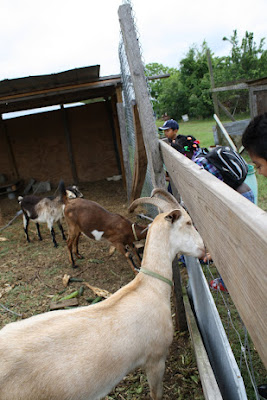
So... for those of you that have followed my blog you will be familiar with my beloved goat Bob and his tail injury. The short story: Bob is a three legged, two year old goat living on Johns Island that has recently suffered a severe bite to the tail from a stallion mini pony. If it sounds ridiculous, well it is. Yet what started as a simple (albeit untraditional) wound quickly turned into a debacle. As a wound located near the dirtiest place known to all mammals, it has been an insanely ridiculous challenge to help heal the open wound. Although the other people on the farm are worried about the survival of the goats, I am the only one with the resources and desire to help dedicate the time to heal them.

After antibiotics, daily visits, salves from fellow farmers, fencing to separate the horses from the goats, a vet visit, more antibiotics, and the use of tail bandages I thought I was making headway. Then the horses started breaking into the goat pen, the wound became even more infected, and I was burning the candle at both ends trying to deal with the whole issue. After a month of driving out to the island after work, discussions of putting the goat down became a topic of conversation on the farm and I realized that something was going to have to give.

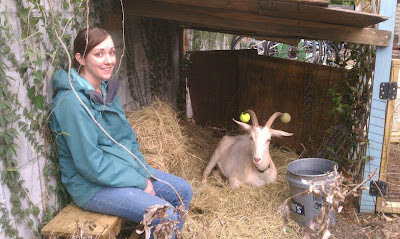
So finally, I decided that the only way I could ensure constant care for my four legged ruminant was to bring it home. With a huge backyard, understanding neighbors, and two gated areas I figured we could pull it off despite living downtown. Technically it can be done legally in our area with signatures from our neighbors, but since we only planned on keep him for a week, we figured we could go with verbal approval until he was better. Dan was onboard, the farmer agreed, and we scooped up Bob for a road trip. With a bale of hay, a bag of feed, tennis balls on his horns for safety, and a bearded friend, Bob was escorted over the river and through the woods to our house downtown.

Bob and Dan bonded on the trip over in such a big way- he followed his every move like a shadow. Dan had built a manger inside our double fenced yard complete with bedding, food, and water. Once in his paddock, it became clear that our generally quiet friend was actually very vocal and was clearly worried about being alone. Every time he lost sight of Dan, he completely fell to pieces, bleating desperately, looking for his truck bed comrade. To help ease the transition, we worked in the yard, hung out near his pen, and hung out with him for a few hours. We pondered on the question: Is this the best idea ever or the worst idea ever? But as he settled in, he started munching on lettuce, hay, and grain. As it started to rain, he curled up for
the evening in his new home and started to drift off.


The next morning I woke up and headed out to the pen to check on our new roommate. When I opened the gate, he was no where to be found. We searched high and low but he was gone. My immediate thought was that he had been stolen because there was no way he could have gotten through two gates. We looked for clues, a note, anything but had no luck. Dan and I walked through our neighborhood, looking into yards and listening for goat cries while I teetered on the edge of hysteria at the thought of him being killed. Without any luck, we decided to call Animal Control to see if a loose goat had been reported. To our surprise, they knew all about it.

In the end, Animal Control had come in the middle of the night, gone through both gates, and taken Bob with out leaving so much as a note or a knock on the door. We ended up at the pound waiting for them to open and once they did, there was no goat. In the end, Bob had been taken to Veterinary Specialty Care in Mt. Pleasant. Thankfully, they were so gracious and loving towards our Bob- they shared our frustration with the situation and the lack of consideration that was given to the animal. So, after all of this, we ended up having to take Bob back to Johns Island.

In the end- I think it ended up falling into the "bad idea" category and I regret ever having put Bob in this position. The silver lining is that Dan and Bob have developed a new found love for each other and I have found a great new emergency vet.